
Transforming the complexity of infinite mass customisation into a perfectly predictable, fast, and cost-effective production flow.
The Technical Problem
The Challenge of Complexity
Modern industry is facing a wall: how to reconcile industrial production volume with unit customisation requirements, without blowing deadlines or IT costs? The MagicBook project initially stemmed from a simple user need: to prevent customers from spending hours on their computer designing a personalised photo book. This challenge then transformed into a brutal business constraint: a partner's decision to halve production time, from 48 hours to 24 hours, while drastically increasing volumes.
The real friction is not mechanical, it is related to the combinatorial nature of the data:
Extreme volumes: An average production of 2500 books per day, with critical peaks reaching 25,000 books over a 4-day weekend requiring the processing of millions of photos daily.
Infinite nomenclatures and ranges : Over 110 design styles associated with hard production variables.
Types of bindings : Layflat, Perfectbound, Standard, Deluxe, Stapled.
Covers and finishes : Hard, Soft, Eco Leather, Premium, Genuine, Acrylic, with Matte, Glossy, Softtouch, Linen finishes.
Structural sequencing Layouts defining the architecture of notebooks like complex sequences such as CPSPC or CSC.
The Solution
The Architecture 56k.CLOUD
Our approach rejects IT tinkering. We deploy the digital backbone of production by strictly following our three-step methodology.
DEPLOY
The Scalable Infrastructure. The urgency was to support the massive load. We deployed an AWS Cloud architecture capable of ingesting millions of high-resolution images without latency. The computing power adjusts dynamically to absorb seasonal order peaks, ensuring absolute stability for production.
UNIFY
The B2B Engine and Automation. The system acts as a seamless intermediary platform. It connects our partners' sales interfaces directly to the print workshop format. Instead of forcing 400 designers to work faster, the engine automates the placement rules. The design adapts to the print nomenclature, for example, by activating panoramic images only for flat bindings. A qualification tunnel filters production upstream: computing power is only allocated to high-potential orders, identified by variables such as image density.
AUGMENT
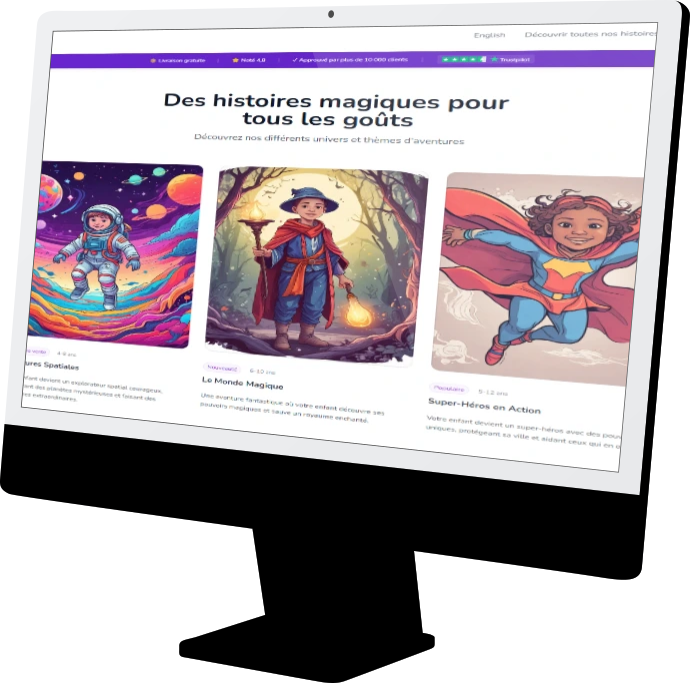
Agentic AI and Compliance. Once the flow is unified and secured, we integrate artificial intelligence for autonomous decisions. The ingestion of photos requires instant analysis to detect faces, calculate areas of interest, and define the optimal layout. For the Little Legend product innovation, bimodal language models generate personalised stories and illustrations. An edge processing architecture transforms children's photos into anonymised caricatures before their transfer to off-shore teams.
The Business Outcome
The ROI
The alignment of IT with operations has transformed what was a bottleneck into a massive competitive advantage.
Blistering execution speed : The platform generates the complete mock-up of a book containing 200 to 300 photos in six seconds.
Hybrid sales model : The technology allows for two levels of service. A fully automated high-margin, high-volume offering, and a premium offering where automation does 80% of the work, leaving the expert human touch to finalise the product for customers willing to pay more.
Exceptional conversion rate : Interaction with the platform engages the customer. When a user requests a change to the generated mock-up, whether it be text or an image, the probability of order validation reaches 95%.
Demonstrated scalability : The Cloud architecture handles the transition from 2,500 to 25,000 daily orders during seasonal peaks without latency.
Discover our programme Digital Forge
We deploy this cyber-physical architecture in 3 days.